

How Much Money Does Mexico Spend On Military
| Mexican Armed services | |
|---|---|
| Fuerzas Armadas de United mexican states | |
 Monument to the Boy Heroes at the Mexican Military Academy | |
| Founded | 1821 |
| Service branches |
|
| Headquarters | Mexico City |
| Leadership | |
| Commander-in-principal |  Andrés Manuel López Obrador Andrés Manuel López Obrador |
| Secretary of National Defense force |  General Luis Cresencio Sandoval General Luis Cresencio Sandoval |
| Secretary of the Navy | Admiral José Rafael Ojeda Durán |
| Personnel | |
| Military age | 18[1] |
| Conscription | Yes |
| Active personnel | 277,150[2] (ranked 18th) |
| Reserve personnel | 81,500[ii] |
| Expenditures | |
| Budget | Us$11 billion (2021) [iii] |
| Percent of GDP | 0.6% (2014 est.) |
| Related articles | |
| Ranks | War machine ranks of Mexico |
 Mexican Army
 Mexican Air Force
 Mexican Navy
The Mexican Armed Forces (Spanish: Fuerzas Armadas de México) are the military forces of the Mexico. The Spanish crown established a standing military in colonial Mexico in the eighteenth century.[4] After Mexican independence in 1821, the military played an important political role, with army generals serving as heads of state.[5] Following the collapse of the Federal Army during the 1910-1920 Mexican Revolution, former revolutionary generals systematically downsized the size and power of the war machine.[vi] Currently the Mexican military forces are composed of two contained entities: the Mexican Regular army and the Mexican Navy. The Mexican Army includes the Mexican Air Strength, while the Mexican Navy includes the Naval Infantry Strength (Marine Corps) and the Naval Aviation (FAN). The Army and Navy are controlled by two separate government departments, the National Defense Secretariat and the Naval Secretariat, and maintain ii contained bondage of command, with no joint command except the President of Mexico.
History [edit]
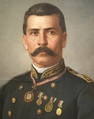
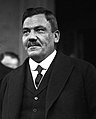
The Spanish crown established a continuing military in the tardily eighteenth century to shore upwardly the defence force of New Spain against foreign attacks. With the outbreak of the Mexican State of war of Independence, the purple regular army fought insurgents for independence. Royal army officer Agustín de Iturbide changed sides and made a pact with insurgent general Vicente Guerrero, bringing about independence. Iturbide became Emperor of United mexican states, but was forced to forsake by military officers. Mexico became a republic with a weak primal government. General Antonio López de Santa Anna was to dominate politics for decades. Following the disastrous Mexican-American State of war, Santa Anna was ousted and civilian liberals took ability, passing a serial of laws removing military privileges and decreasing its power. The conservative military machine and the Roman Cosmic Church centrolineal in an unsuccessful attempt to oust the liberal reformers in a civil war. In 1862 French republic invaded United mexican states to collect debts repudiated by the liberal government and Conservatives approached France'southward ruler Napoleon Iii to select a monarch for Mexico. Many Mexican republicans fought the French army, winning a brief victory on 5 May 1862. The French withdrew all war machine support for Emperor Maximilian in 1867. Liberal republicans returned to ability and executed Maximilian and two Mexican generals supporting his authorities. An of import liberal military machine leader against the French and their bourgeois Mexican collaborators was General Porfirio Díaz. Díaz had political ambitions to become President of Mexico, rebelling twice against civilian presidents, succeeding in 1876. He ruled United mexican states continuously from 1884 to 1911, when he was forced from ability by Mexican revolutionaries supporting Francisco I. Madero. Although revolutionary forces defeated the Federal Army, Madero demobilized them and retained the federal forces. Madero was overthrown and murdered in a military machine coup in February 1913. Federal Ground forces General Victoriano Huerta, now president, was challenged past a coalition of revolutionaries in northern Mexico, the Constitutionalist Ground forces and forces led past Emiliano Zapata in the south. The Constitutionalists defeated the Federal Ground forces in July 1914 and it was dissolved. Only revolutionary armies remained, which were non a unified force. Revolutionary generals were unable to come to a power system after their victory over Huerta, plunging the country into a new stage of civil war. The large-calibration conflict largely concluded with Constitutionalist Full general Alvaro Obregón defeating General Pancho Villa in 1915. From 1920 until 1940, revolutionary generals held the presidency of Mexico, with a number of rival generals staging unsuccessful coups. During this same period, these generals, especially Obregón, Plutarco Elías Calles, and Lázaro Cárdenas, systematically downsized the overall size of the armed forces and drastically reduced its share of the national budget, while at the same time creating a professional person and largely apolitical inferior officer corps.[7] President Manuel Avila Camacho (1940-1946) was the last revolutionary-era general to serve as president and military coups were a matter of the past. Mexico's military are notable in Latin America for their absence from politics. Mexico'south revolutionary military leaders established a civilisation of noncombatant supremacy and placed state power in the easily of civilian professional politicians.[8]


System [edit]
The Army [edit]
There are five main components of the Army: a national headquarters, territorial commands, and contained units. The Secretarial assistant of National Defense, thru the Commanding Full general of the Regular army, commands the Army by ways of a very centralized organization and a large number of general officers. The Army uses a modified continental staff system in its headquarters. The Army is the largest co-operative of Mexico's armed services.
Presently, in that location are 12 "Military Regions", which are farther broken down into 44 subordinate "Military Zones." In both cases, a numbering system is used for designation. At that place is no set number of zones within a region, and these can therefore be tailored to come across operational needs, with a corresponding increase or decrease in troop strength.
The Air Force [edit]
The Air Strength national headquarters is embedded in the Army headquarters in United mexican states Metropolis. It also follows the continental staff system, with the usual A1, A2, A3, and A4 sections. The tactical forces form what is loosely called an Air Partition, but information technology is dispersed in four regions: Northeast Mexico, Northwest United mexican states, Central Mexico, and Southern Mexico. The Air Forcefulness maintains a total of 18 air bases, and has the boosted adequacy of opening temporary frontwards operating bases in austere conditions for some helicopters and calorie-free aircraft.
[edit]

The Secretariat of the Navy, the Navy's national headquarters, is located in Mexico Metropolis, and is smaller than the Army's headquarters. The "Junta (or Quango) of Admirals" plays a unique consultative and advisory part within the headquarters, an indication of the institutional importance placed on seniority and "twelvemonth groups" that go back to the admirals' days as cadets in the naval higher. They are a very tightly knit grouping, and peachy importance is placed on consultation amidst the factions within these year groups. The Navy's operational forces are organized as two independent groups: the Gulf Force and the Pacific (West) Force. Each grouping has its own headquarters, a destroyer grouping, an auxiliary vessel group, a Marine Infantry Group, and a Special Forces group. The Gulf and Pacific Forces are not mirror images of each other, as independence of organization is permitted. Both are subdivided into regions, with Regions 1, 3, and 5 on the Gulf, and ii, iv, and six on the Pacific. Each region is further divided into sectors and zones, so a proliferation of headquarters and senior officers exists. The Navy besides has an air arm with troop send, reconnaissance, and surveillance shipping.
The Navy maintains significant infrastructure, including naval dockyards that take the capability of building ships, such equally the Holzinger course offshore patrol vessel. These dockyards have a significant employment and economic touch on in the country.
The Marines [edit]
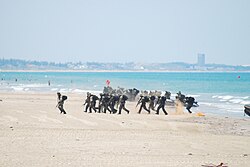
The Mexican Navy commemorate June 1st, National Maritime Mean solar day.
The Naval Infantry are the marine corps and amphibious infantry forcefulness of the Mexican Navy. The chief task of the Infantería de Marina is to guarantee the maritime security of the land's ports and external and internal defense of the land, to accomplish these responsibilities the corps is trained and equipped to take on any type of operations from Ocean, Air and Land.
The Naval Infantry Corps was reorganized in 2007–09 into 30 Naval Infantry Battalions, a paratroop battalion, a battalion attached to the Presidential Guard Brigade, two Fast Reaction Forces with half-dozen battalions each, and 3 Special Forces groups. The Naval Infantry are responsible for port security, protection of the 10-kilometer coastal fringe, and patrolling major waterways.
The Coast Baby-sit [edit]
The Mexican Maritime Search and Rescue is the Mexican Navy's SAR Unit, which is responsible for improving the quality and effectiveness of the Navy'south response to United mexican states'south maritime emergencies. The Mexican Navy historically has been responsible for the search and rescue operations using its available resource. However, aware of the importance of safeguarding homo life at bounding main and the growing need of sea rescue, the High Command of the Navy created the Maritime Search and Rescue unit of measurement.
Independent forces [edit]

Several other military organizations exist that are independent of the Ground forces and Navy command structures.
Chief amongst the independent troops is an Army Corps consisting of ii mechanized infantry brigades located in United mexican states City plus a motorized brigade, with a full complement of combat and back up troops. In improver, there are Special Forces units (1 division and more 100 independent regional battalions) and a parachute brigade.
All these independent troops are located in Mexico City where they act every bit a ready reserve and as centers of excellence.
In times of demand, a special "Rural Defence force Corps" (or "Rurales") plays a role similar to a traditional volunteer militia (organized on an as-needed basis) in the rural communities. Today, Rural Defense teams work with both local law enforcement and the National Baby-sit towards the goal of hindering organized crime and the threat of the drug cartels.
President Andrés Manuel López Obrador, in his countdown message to the Armed forces on 1 December 2018, officially asked the Congress of the Matrimony to consider reactivating the National Guard of Mexico, -every bit a split up service of the armed forces nether the direct control and responsibility of the Secretariats of National Defence and Public Security along similar lines every bit to the reorganized National Baby-sit in France in gild to contribute to overall national defense and help protect public gild and safety. The relevant amendments to the Constitution were approved in March 2019 by both chambers.
Leadership [edit]

Officially, as there is no Government minister of Defense force, the Mexican military's ii components are not nether the control of a single commander except the President, who is Supreme Commander of the Military machine (Comandante Supremo De Las Fuerzas Armadas). According to the Constitution of Mexico the President is the Ground forces'southward only 5-star full general. (This is comparable to well-nigh other countries with a presidential system of regime, such as the United States.) Instead, a Secretary, who is a serving officer—an Army 4-star general or a Navy admiral—heads each department and branch (The Secretariats of National Defense and the Navy). Each minister serves in a dual capacity: as a full cabinet member reporting to the President, and every bit the operational commander of their branch, just because of politics and rank, the Navy is subordinate to the Army.
Moreover, the Air Force commander and his staff are fastened to Army headquarters; no Air Force officer has risen to the hierarchy's most trusted, senior positions. This subordination has allowed the Army to identify its organisation as the "Secretariat of National Defense" (Secretaría de la Defensa Nacional—SEDENA). Equally a upshot, the Army principal holds the nominal title of "Secretary of Defence force."
The President picks the secretaries, who practise non have to serve as such for his entire presidential term (sexenio, sexennium, six-year term). During the PRI's single-political party rule, ministerial pick was a strict, pro-forma exercise by seniority. However, both Presidents Ernesto Zedillo (1994–2000) and Vicente Fox (2000–06) strayed from precedent and reached down to the junior levels to select "more progressive" officers to lead the forces.
The Regular army and the Navy are regionally organized, with central, national headquarters in Mexico Metropolis and subordinate, regional headquarters. Historically, this has proven to be effective because military'southward main deployments have been domestic. Troops are stationed throughout the country to serve as a standing presence of authority and to allow for an immediate critical response. Dispersion past regional armed forces zones has facilitated local recruitment of non-commissioned officers (Army sergeants, Navy petty officers) and enlisted men and women, allowing them to be stationed virtually family unit during their military service, an important cultural consideration. On the other hand, mobility is expected of commissioned officers to give them experience, and historically, to prevent whatever senior officer from remaining also long and becoming a warlord.
Upkeep [edit]

Mexican Army Special Forces.

Armed forces parade commemorating the 205th anniversary of the beginning of the Mexican War of Independence.
In 1989, Mexico'south armed services budget was 0.7 percentage of the country's Gross National Product (GNP). In 1999, Mexico'due south military budget increased to 0.9 percent of its Gross domestic product, to US$four.0 billion. Since the year 2000, however, with the economic boost that the country has experienced, the defense force budget was decreased to 0.five percent of the Gdp, and in 2007 had an almanac expenditure of US$4 billion. Since President Calderón causeless office in December 2006, he has submitted legislation increasing the budget, in order to fight the drug war against the narcotics cartels, and narcotic drug trafficking in full general. In 2012, Mexico spent United states of america$7.1 billion on its war machine, amounting to 0.6 per centum of GDP.
Since 2012, Mexico has spent over US$3 billion in equipment purchases equally function of a modernization attempt, including the buy of Blackhawk helicopters.[9]
Mission [edit]

The Mexican Army works effectually three preparedness missions, or plans:

DN1: Grooming of the war machine forces to repel external aggressions. No military armed force tin leave Mexican territory without a declaration of state of war, and approval of the Congress. The final time this was invoked was in 1942, to send an expeditionary force to the Philippines, after war was declared against Frg and Japan, following the sinking of two Mexican ships past U-boats. In 1990, President Carlos Salinas de Gortari asked the permission of the Congress to send troops to the Gulf War, merely it was refused, since there was no annunciation of state of war against Iraq.

DN2: Preparation of the military forces to protect the internal security of the country. This would include police actions against guerrilla forces, counter-drug operations, and, originally, political control. Up until 1970, the Mexican Army was used equally a repressive force to maintain the virtual PRI dictatorship. The most controversial use of the armed forces was the Muddied War in the 1960s, which included the 1968 Tlatelolco massacre of students and unsuspecting bystanders. After 1980, these operations near entirely ceased (see EZLN).
DN3: (Defense against natural disasters). The Army should always be prepare to aid the civil population in case of disaster. This includes preventive measures. For case, betwixt Baronial and November, military machine forces are sent to Mexican coastal areas to assistance the public in the event of hurricanes or floods. For the Mexican people, the DN3 plan is the most important peacetime operation of the Army. The Ground forces provides food, shelter, medicine, and medical services to the people who need them. This also includes reconstruction of roads and communication services. Because calling the implementation DN3 plan is an acceptance of astringent problems, the DN3 programme was not invoked in the 1985 Mexico City earthquake that left large areas of Mexico City in ruins, since the authorities did not want to recognize at that place was an emergency in the capital, while the army was called to the city, it was simply a peacekeeping force. This later became a severe questioning on the regime. The Mexican Army provided aid to the US post-obit Hurricane Katrina. More recently, the DN3 plan was invoked in 2009 when an epidemic of swine flu threatened the population and in 2010 afterward the states of Veracruz, Tabasco, Nuevo León, Chiapas, Oaxaca and Guerrero were severely affected by floods caused by a number of hurricanes and tropical storms.
Personnel [edit]
Officers [edit]
Officer candidates for the three services are trained in military colleges; United mexican states Metropolis for the Ground forces, Guadalajara, Jalisco, for the Air Force, and Veracruz, for the Navy.
Career soldiers [edit]
Mexican citizens who take chosen to be career soldiers are signed for an initial 3-year contract and, at the end of it, are encouraged to sign for some other 2-year contract. If they choose to practice and so, this 2nd term would become concluding, unless they undertake mandatory exams and tests to get corporals, or apply to study in whatever of the available Armed services Specialist Technical Schools or for sergeant in the E.G.C.A. (Escuela Militar de Clases de las Armas) (Army).
Induct soldiers [edit]

The armed forces are generally made up of professionals. Armed forces service age and obligation equally of 2012 is 18 years of age for compulsory military machine service, conscript service obligation is 12 months; conscripts serve merely in the Army; Navy and Air Force service is all voluntary. Women are eligible for voluntary military service.[10]
Legally, every Mexican human being is obligated to a year of war machine service consisting of a few hours of drill or social services on weekends, not true military machine grooming. Most conscripts will take received at most only one marksmanship session at a rifle range by the fourth dimension they have completed their service and are not integrated nor operate with regular army units.
National armed services service [edit]
The drafted men attend and participate in weekend sessions, which are of social service in nature, with an emphasis being placed on educational activity, history, physical fettle, and military discipline for one complete year. Afterward, the precartilla (pre-military identity card) is returned to the conscript with an added page certifying his status as having fulfilled his national military service and identifies the war machine co-operative, the unit of measurement, rank, etc. The certificate and so acquires full status as the Cartilla del Servicio Militar Nacional (Military machine National Service Identity Carte du jour), informally Cartilla; this status is recorded in the National Defense and Navy Secretariats' files.
This document (War machine National Service Identity Bill of fare) is an of import class of Mexican national identification, and its being was formerly ever requested by private and public employers, even so, this identity document has ceased being required for obtaining a passport for international travel.
Armed forces Police [edit]
As the President of Mexico is Commander in Chief of the armed forces, the chain of command and military discipline are subordinated to civilian command. Article 13 of the Mexican Constitution specifically provides for military jurisdiction over all military offense and discipline; military tribunals execute jurisdiction over military personnel, per the Compatible Lawmaking of Armed forces Justice (UCMJ).
Regarding military machine personnel labor weather condition, discipline, and the chain of control as central to the armed forces, Article 123-B establishes: "Military and naval personnel and members of the public security corps, and personnel of the foreign service, shall be governed by their own laws."

Article 129 of the 1917 Political Constitution of the Mexican Usa establishes that: "No military authority may, in time of peace, perform any functions other than those that are straight connected with armed forces affairs", merely the Army's temporary replacement of civil police forces, in specific cases, before the cosmos of the Federal Police, has been much debated in Congress and in the mass communications media.
In a similar way in Article 26: "No member of the army shall, in time of peace, be quartered in private dwellings without the consent of the owner, nor may he impose any obligation whatsoever. In time of war the military machine may demand lodging, equipment, provisions, and other assistance, in the style laid down in the respective martial police force."
Activities outside Mexico [edit]
United nations peacekeeping [edit]

As of 2005, intervention in UN peacekeeping operations began being discussed, with strong resistance from some members of the Congress. However, in 2016 the first group of the Mexican Armed Forces joined MINUSTAH, the UN mission in Haiti: three officers (ane from each service) as members of the mission's HQ, and two officers and ane NCO attached to the Chilean battalion, by an agreement between the two countries. Mexican authorities have expressed their interest to increment their participation in the future.
Natural disaster relief [edit]
The Mexican Armed Forces has been deployed to several Central American countries to provide disaster relief, and most recently, to Republic of indonesia after the tsunami disaster; but military support personnel were deployed, though, non combat forces. This includes the relief efforts in New Orleans after Hurricane Katrina. This was the first fourth dimension the Mexican Army officially entered its former territory since the Mexican-American war. Mexican relief efforts were concentrated in Texas and New Orleans.
Run into also [edit]
- Army ranks and insignia of Mexico
- Brigada de Fusileros Paracaidistas
- Fuerzas Especiales
- Grupo Aeromóvil de Fuerzas Especiales
- Grupo Aeromóvil de Fuerzas Especiales del Alto Mando
- Ixtoc-Alfa
- Mexican Air Force
- Mexican military ranks
- Mexican response to Hurricane Katrina
- Mexican Special Forces
- Armed forces history of Mexico
References [edit]
- ^ "CIA – The World Factbook – Mexico". Fundamental Intelligence Agency. Retrieved 2009-11-24 .
- ^ a b IISS 2018, pp. 411-412
- ^ "Information" (PDF). www.sipri.org.
- ^ Archer, Christon I. The Army in Bourbon Mexico, 1760–1810. Albuquerque: University of New Mexico Press 1977.
- ^ Archer, Christon I. "Military machine: 1821–1914" in Encyclopedia of United mexican states. 904–910
- ^ Lieuwen, Edwin. Mexican Militarism, 1910-1940: The Political Ascension and Fall of the Revolutionary Army. Albuquerque: University of New Mexico Press 1968; reprinted By Greenwood Press 1981.
- ^ Lieuwen, Edwin. Mexican Militarism: The Political Ascension and Fall of the Revolutionary Regular army, 1910-1940. Albuquerque: University of New Mexico Press 1968.
- ^ Campsite, Roderic Ai, United mexican states's Military machine on the Democratic Phase. Westport CT: Praeger Security International 2005, 15
- ^ Partlow, Joshua (15 June 2015). "What'due south backside Mexico's military buying binge?". Washington Mail. United States. Retrieved xv June 2015.
- ^ "CIA – The World Factbook – United mexican states". Central Intelligence Agency. Retrieved 2015-02-23 .
Farther reading [edit]
- Camp, Roderic Ai. Generals in the Palacio: The Military in Modern Mexico. New York: Oxford University Press 1992.
- Camp, Roderic Ai, Mexico'south Military on the Democratic Phase. Westport CT: Praeger Security International 2005.
- Carriedo, Robert. Military professionalism and political influence: a case study of the Mexican military, 1917-1940. Vol. 93. Academy of Florida, 1992.
- International Plant for Strategic Studies (xiv February 2018). The Military Residue 2018. London: Routledge. ISBN9781857439557.
- Moyano, Inigo Guevara. Adapting, Transforming, and Modernizing Under Fire: The Mexican Military, 2006-11. No. fifty. Strategic Studies Plant, US Army War College, 2011.
- Williams, Edward J. "The Development of the Mexican Military and Its Implications for Ceremonious-Military Relations." Mexico'south Political Stability: The Next Five Years. Routledge, 2019. 143-158.
External links [edit]
- Entry for United mexican states in the CIA World Factbook
- The Mexican Armed Forces in Transition – Jordi Díez and Ian Nicholls [1]
- Sergio Aguayo Quezada (Editor) El Almanaque Mexicano. México: Editorial Hechos Confiables. 2000.
- Christopher F. Foss. (Editor) Jane's Pocket Book of Modern Tanks and Armored Fighting Vehicles. New York: Collier Books. 1974.
- Christopher F. Foss. Jane'southward Tank and Gainsay Vehicles Recognition Guide. New York: Harper Collins Publishers. 2000.
- Verónica Macías "Para Las Fuerzas Armadas y Justicia 150,326 mdp". El Economista Peridico de Negocios y Economia.
- (in Castilian) National Defense Secretariat.
- (in Spanish) Navy Secretariat.
- (in Spanish) http://world wide web.fasoc.cl/files/articulo/ART4117e2978fedb.pdf
- (in Spanish) Unofficial Military Forum MEXICAN Armed services
- Photos/MEXICAN ARMY, NATIONAL MARINE AND AIR FORCE
- Video 2006 Mexican Forces Parade
Source: https://en.wikipedia.org/wiki/Mexican_Armed_Forces
Posted by: bassqual1986.blogspot.com
0 Response to "How Much Money Does Mexico Spend On Military"
Post a Comment